



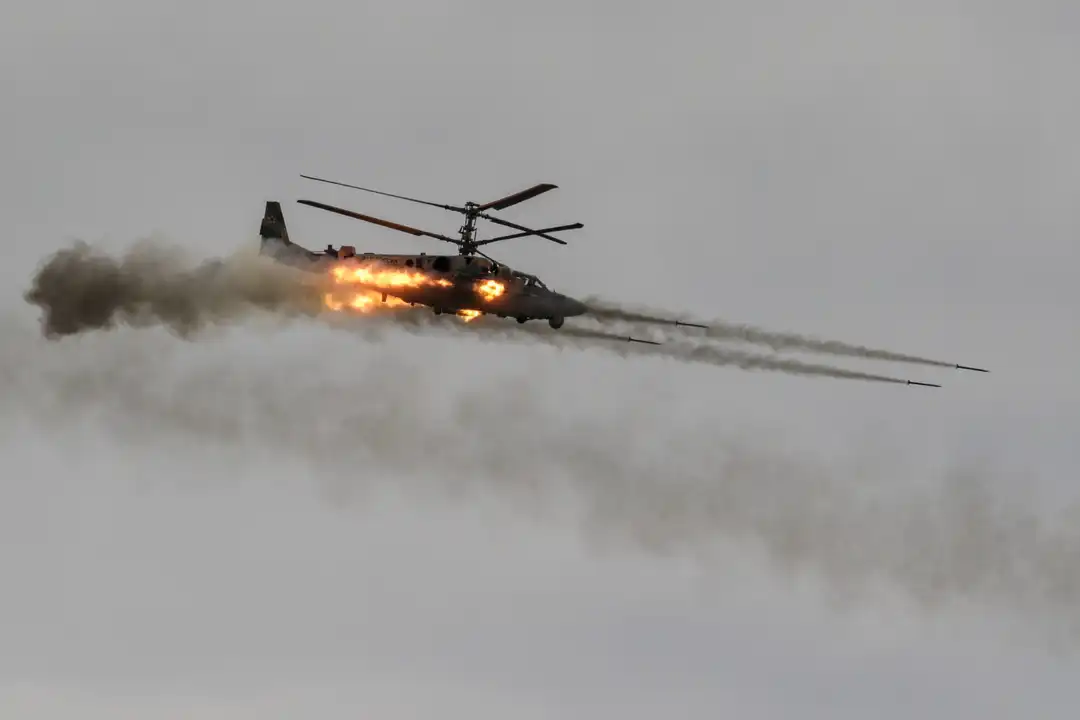
DONETSK REGION, UKRAINE – Russian Kamov Ka-52 “Alligator” attack helicopters, valued at approximately $16 million each, have recently been impacted by both Ukrainian FPV drone attacks and incidents of friendly fire, underscoring the complex and evolving nature of modern aerial combat.
In the Donetsk region, Ukraine’s Unmanned Systems Forces reported the destruction of a Russian Ka-52 helicopter by an FPV drone. The “Predators of the Heights” battalion of the 59th Separate Assault Brigade of the Unmanned Systems Forces claimed responsibility for the strike, which they documented with a corresponding video, according to Ukrinform, the Ukrainian National News Agency. This marks the second Ka-52 helicopter reportedly accounted for by the 59th Brigade.
The incident highlights the increasing effectiveness of FPV drones in targeting high-value military assets. Following the emergency landing, the helicopter crew was detected and eliminated by pilots of the 1st Battalion of the 414th “Magyar’s Birds” Brigade, the Unmanned Systems Forces stated. The Ka-52 is a sophisticated reconnaissance and attack helicopter, designed for destroying armored vehicles, personnel, and aerial targets.
Friendly Fire Incident in Voronezh
Separately, a Russian Ka-52 attack helicopter that crashed in Russia’s Voronezh region on July 2 was likely brought down by friendly fire. UNITED24 Media reported that the incident occurred as Russian forces attempted to repel a Ukrainian drone attack. Citing Russian military blogger Vladimir Romanov, via The Insider, the helicopter was mistakenly hit by a Verba man-portable air defense system (MANPADS).
The MANPADS was reportedly operated by a mobile fire group from Russia’s BARS (Combat Army Reserve) units. Romanov’s account points to significant organizational and training shortcomings within Russia’s mobile air defense groups. He contrasted well-trained, coordinated military personnel with “volunteers” who receive minimal training and are then tasked with firing “blindly ‘toward the target’,” leading to “unfortunate consequences.” This incident occurred amidst a broader context of Moscow drone attack brings war closer to home, as Ukrainian unmanned aerial vehicles increasingly penetrate Russian airspace.
Operational Challenges and Drone Warfare
These events illustrate the dual threats faced by traditional military aviation assets in contemporary conflicts. While the Ka-52 “Alligator” has been a prominent feature in Russian military exercises, such as the annual Army Games defense technology exhibition, and was even showcased at events like the Dubai Airshow, its battlefield vulnerability to both advanced drone warfare tactics and internal operational failures is becoming increasingly apparent.
The use of FPV drones by Ukrainian forces represents a growing trend in asymmetric warfare, where relatively inexpensive unmanned systems can neutralize much costlier conventional military equipment. This shift is part of a wider adoption of drone technology that is reshaping global conflict, as seen in various theaters where FPV Drones: The Unseen Force Reshaping Global Conflict and Defense are becoming critical.
The friendly fire incident further highlights the critical need for robust command, control, and communication systems, especially when countering drone threats with distributed air defense assets. Such incidents can significantly degrade operational effectiveness and morale. The ongoing conflict continues to provide stark lessons on the integration of new technologies and the challenges of maintaining effective defense operations against evolving threats.