



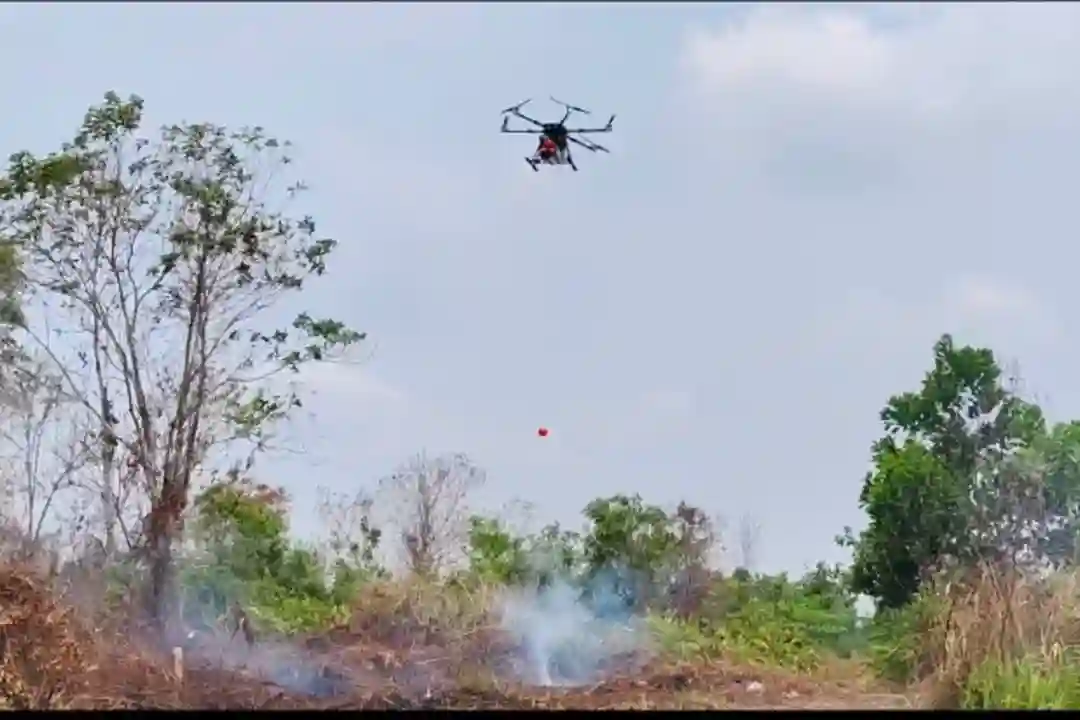
DRONE BOMBS DEPLOYED TO COMBAT KAMPAR WILDFIRES FOR FIRST TIME KAMPAR, RIAU – A new era in wildfire suppression began in Kampar, Riau, as drones equipped with dry powder bombs were utilized for the first time to extinguish hotspots in peatland fires. This innovative approach marks a significant step in combating the persistent challenge of land and forest fires (Karhutla) in the region. The technology offers a targeted and potentially more efficient method for tackling nascent outbreaks before they escalate. The successful deployment of these specialized drones represents a critical advancement in wildfire management strategies. While traditional methods continue to be employed, the integration of drone technology signals a move towards more technologically driven solutions for environmental protection. This initiative highlights the growing role of unmanned aerial vehicles (UAVs) in addressing complex environmental issues. The use of drones for fire suppression is not entirely new, but the specific application of delivering dry powder bombs directly onto hotspots demonstrates a novel tactic. This method aims to neutralize fires at their earliest stages, preventing them from spreading and causing widespread damage. The effectiveness of this approach is particularly crucial in peatland areas, which are notoriously difficult to extinguish once ignited. This groundbreaking use of drone technology in Kampar is a testament to ongoing efforts to innovate and adapt to environmental challenges. As wildfire seasons become more unpredictable, such advancements are vital for protecting ecosystems and communities. The initiative is expected to be closely watched by other regions facing similar threats. ## Innovative Drone Technology Targets Early Fire Outbreaks The drones deployed in Kampar are designed to carry and release “fire balls,” a type of extinguishing agent. According to research, this technology aims to develop and modify drones capable of carrying and precisely releasing fire balls, which are fire-extinguishing materials, onto targets. This capability is especially valuable for tackling initial fire outbreaks covering an area of approximately half a hectare. By intervening early, these drones can prevent fires from expanding into larger, more uncontrollable infernos. The effectiveness of this system is particularly pronounced in challenging terrains like peatlands. These areas are prone to smoldering fires that can persist underground for extended periods, making them difficult to detect and extinguish using conventional methods. The precise delivery mechanism of the drone allows for targeted application of the extinguishing agent directly to the source of the fire, maximizing its impact. This precision reduces the need for large-scale water bombing, which can be less effective on peat fires and can also cause environmental damage. As reported by
Kompas.com
, the drone is effective in extinguishing initial fire points with an area of up to half a hectare. This capability is crucial for early intervention, a key strategy in wildfire management. The ability to neutralize small fires quickly can prevent significant ecological and economic damage. Furthermore, the development and application of such technology align with the broader trend of utilizing UAVs for various public safety and environmental monitoring tasks, as seen in other sectors like
shark sighting surveillance
and infrastructure inspection. ## Challenges and Future of Drone Firefighting Despite the promising initial deployment, challenges remain in the widespread adoption and effectiveness of drone-based firefighting. One significant aspect is the operational environment. As highlighted by the
BPBD Kabupaten Kampar
, the public is urged not to fly drones near active fire sites during water bombing operations. This advisory underscores the need for strict airspace management and coordination between different drone operators and emergency services to prevent interference and ensure safety. The effectiveness of these drones is also dependent on the type and scale of the fire. While they are ideal for initial outbreaks, larger, more established fires may still require traditional firefighting methods, including the deployment of ground crews and aerial water drops. However, drones can play a crucial supporting role by providing real-time aerial surveillance, identifying hotspots, and delivering targeted suppression agents to areas that are difficult for ground teams to access. This integrated approach can significantly enhance the overall efficiency of firefighting operations. Looking ahead, the research and development in this field are continuous. Studies like the one focusing on the modification of drones to carry fire balls aim to refine the technology further. This includes improving payload capacity, battery life, and the precision of fire ball deployment. As the
low-altitude economy
continues to grow, the integration of specialized drones for critical services like firefighting is expected to become more prevalent. This aligns with the broader vision of using UAVs to bolster the
low-altitude economy ecosystems
. ## Regulatory and Technological Landscape The integration of advanced drone technology into critical operations like wildfire suppression also brings regulatory considerations to the forefront. As Indonesia continues to develop its
airspace management framework
, ensuring that specialized applications like firefighting drones can operate safely and effectively is paramount. This includes establishing clear protocols for flight operations, airspace deconfliction, and data sharing among emergency response agencies. The
Indonesian drone laws
are evolving to accommodate diverse applications, a trend mirrored globally. Technologically, the advancements in drone capabilities are rapid. Innovations in battery technology, sensor systems, and payload delivery mechanisms are continuously enhancing the potential of UAVs. For firefighting, this could translate into drones capable of carrying larger payloads, operating for longer durations, and even deploying water or other extinguishing agents with greater precision. The development of autonomous capabilities, guided by artificial intelligence, could further revolutionize how fires are detected and managed, potentially reducing human risk and improving response times. This mirrors advancements seen in other fields, such as the integration of electromechanical actuators in rockets for enhanced control, as demonstrated by ISRO. The potential for drones in disaster response is vast, extending beyond firefighting. They can be utilized for search and rescue operations, damage assessment, and delivering essential supplies to affected areas, particularly in remote or inaccessible regions. As seen with
drone cargo initiatives
, UAVs are increasingly being explored for logistical support. The ongoing development and successful deployment of specialized drones like those used in Kampar signal a promising future for leveraging technology to mitigate the impacts of environmental challenges. The use of drones in Kampar also highlights the growing importance of specialized drone training and education. As the technology becomes more sophisticated and its applications more diverse, the need for skilled operators and maintenance personnel increases. Initiatives like those discussed at the
Hubei International Technology Exchange Conference
, which gather global innovators, and the focus on
drone training
are crucial for building a robust and capable drone ecosystem. Such advancements are vital for empowering regions like Indonesia to effectively utilize drone technology for national development and disaster management.