



Leipzig drone attack allegations from Berlin have drawn a sharp rebuttal from Moscow. Russian President Vladimir Putin on Tuesday accused Germany of planting evidence to blame Russia for the attempted strike at Leipzig/Halle Airport. According to the BBC, Putin offered no evidence to support his counter-claim.
The Russian embassy in Berlin, meanwhile, dismissed the German accusation as “absurd.” Its ambassador went further, according to a Reuters report carried by Global Banking and Finance. He “categorically rejected the accusations levelled by Berlin as unsubstantiated, absurd and contrary to common sense.”
The diplomatic clash follows a Berlin press conference on Tuesday, September 1, 2026. There, Interior Minister Alexander Dobrindt and Foreign Minister Johann Wadephul named Russia as the party behind the failed attack. Consequently, Germany announced a series of retaliatory measures, including the closure of a Russian consulate.
The incident itself dates back to August 4. On that day, investigators discovered a drone carrying an explosive device at the eastern German airport, close to Ukrainian cargo planes. The device failed to detonate because its detonator was apparently faulty, the BBC reported.
What Germany Says Happened at Leipzig/Halle
According to the BBC, German investigators suspect a second drone collided with a cargo aircraft parked nearby. Moreover, a third drone was reportedly found near the airport roughly 10 days later. The sequence of events therefore suggests a coordinated effort rather than an isolated incident.
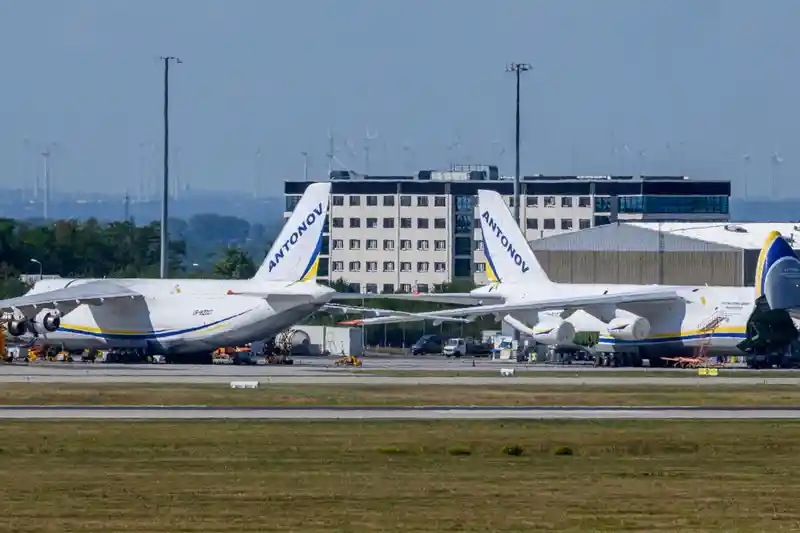
Photographs distributed by AP News show Ukrainian Antonov aircraft parked behind a fence at the airport in Schkeuditz. Police forensic technicians worked alongside a bomb-disposal robot near one of the Ukrainian planes. Investigators removed the detonator from the object before examining it further.
Dobrindt told reporters that the operation matched a “well-established pattern of Russian hybrid operations in Europe.” Furthermore, he said examination of the equipment used, combined with intelligence findings, proved Russian involvement. He added that Germany assumes it will be targeted again.
Putin Turns the Accusation Back on Berlin
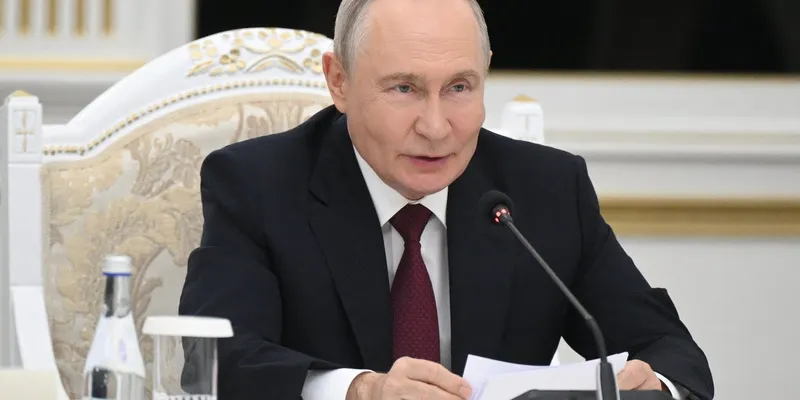
Putin framed the German announcement as a political maneuver. Speaking to reporters, he tied the allegation to the domestic troubles of Chancellor Friedrich Merz. “I believe it has to do with the domestic political situation in Germany. The chancellor is facing dire times,” Putin said, as reported by HuffPost via Yahoo News.
The Russian leader then attacked Merz personally. “He does not enjoy the trust of his people because he does not protect national interests. He is selling German national interests,” Putin said. In addition, he pointed to Germany’s economic situation as a motive for what he described as a distraction.
“They have made obvious mistakes in the economy,” Putin continued. “People are losing jobs. The living conditions are becoming worse. And one cannot understand why they do this.” Notably, none of these remarks addressed the physical evidence German authorities say they collected at the airport.
Russian Officials Call Claims a Pretext
Beyond Putin’s comments, Russian officials coordinated a broader rejection. AP News reported that a Russian official dismissed claims of Russian involvement as a “far-fetched and contrived pretext” for Berlin’s subsequent actions. The phrasing suggests Moscow views the German measures as the true objective, with the drone incident serving as justification.
The Russian embassy in Berlin echoed that position. It labeled the allegation of Russian responsibility “absurd,” according to the BBC. Similarly, the ambassador’s statement described the accusations as “unsubstantiated” and “contrary to common sense.”
However, Russia has not offered an alternative explanation for who operated the drones or why they appeared near Ukrainian cargo aircraft. Instead, Moscow’s response has focused on questioning German motives. This pattern mirrors previous Russian reactions to European accusations of sabotage and interference.
Germany Orders Retaliatory Measures
Germany responded to its findings with concrete diplomatic steps. Foreign Minister Wadephul, standing beside Dobrindt at the Berlin press conference, said he would order the closure of the Russian consulate in Bonn. He also moved against the Russian House in Berlin, a cultural center, according to the BBC and HuffPost.
Al Jazeera confirmed that Germany ordered “a series of measures” in response to the attempted attack. These steps mark a significant escalation in the already strained relationship between Berlin and Moscow. Furthermore, they signal that Germany considers the Leipzig incident a matter of state security rather than ordinary crime.
European allies quickly rallied behind Berlin. NATO Secretary-General Mark Rutte wrote on X that the alliance “stands in full solidarity with Germany,” HuffPost reported. Therefore, the dispute has moved beyond a bilateral quarrel into a wider transatlantic security discussion.
Why Ukrainian Cargo Planes Matter
The location of the drone near Ukrainian cargo aircraft is central to the German case. Leipzig/Halle Airport hosts Ukrainian Antonov planes, as AP photographs show. Consequently, German officials view the attempted strike as connected to the ongoing war in Ukraine.
That conflict has increasingly spilled beyond the front lines through drone warfare. Ukraine has repeatedly struck deep inside Russia, as UAS Daily reported in Ukraine Unleashes Massive Drone Attack Across Russia and Crimea. Meanwhile, Russian civilians have also felt the war’s reach, as detailed in Moscow drone attack brings war closer to home.
The Leipzig incident, however, represents something different. It involves alleged hostile drone activity on NATO territory against civilian aviation infrastructure. As a result, European governments are reassessing how vulnerable their airports remain to small, explosive-laden unmanned aircraft.
Hybrid Operations and Airport Security
Dobrindt’s reference to “hybrid operations” places the incident within a broader European security concern. Such operations typically combine deniable physical acts with information campaigns. Notably, Putin’s counter-accusation that Germany planted evidence fits the information-warfare dimension of that model.
The technical details also raise questions for airport operators. Small drones carrying explosives are cheap and difficult to detect, a reality explored in FPV Drones: The Unseen Force Reshaping Global Conflict and Defense. Moreover, a faulty detonator, rather than airport defenses, appears to have prevented an explosion at Leipzig.
Counter-drone technology has therefore gained urgency across Europe. Nevertheless, the market for such systems remains volatile, as UAS Daily noted in its coverage of DroneShield Stock Plunges Over 50% Despite Record Sales and Pentagon Contracts. Airports may now face pressure to accelerate procurement regardless of cost.
What Comes Next
Germany has signaled that it expects further incidents. Dobrindt’s statement that Berlin assumes it will be targeted again suggests heightened alert levels at critical infrastructure. Additionally, the closure of Russian diplomatic and cultural facilities will likely prompt reciprocal action from Moscow.
Russia, for its part, has shown no sign of backing down. Putin’s decision to personally address the matter and attack Merz indicates that Moscow intends to contest the narrative aggressively. Consequently, the dispute may deepen an already frozen relationship, with implications for stalled diplomacy covered in Russia Ukraine peace talks elusive but efforts continue.
For now, the two governments present irreconcilable accounts. Berlin says equipment analysis and intelligence prove Russian responsibility. Moscow says the evidence was planted and the accusation is a pretext. Neither side has publicly released the technical findings that could settle the question.